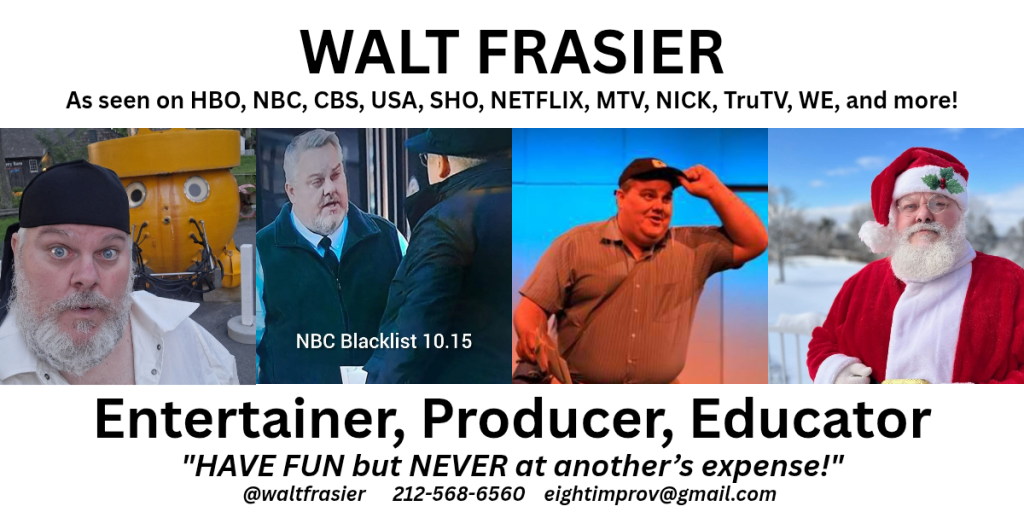
[00:00:28] Steve: Welcome everybody, welcome back to Magical Memories Unlocked, your guide to event success. This is another one of our entertainer deep dives. Today we have Walt with us. Walt is a world-traveling funny man of sorts, he is an improv expert, he does a whole lot of different exciting fun things… Walt, would you like to introduce yourself?
[00:01:04] Walt: Hey, how’s everybody doing? My name is Walter Frasier. Steve said, I do improv comedy, I do murder mysteries, I work with corporate events, colleges, and K-12 outreach. We’re the home of Improv 4 Kids. I’m the artistic director of the New York Improv Theater—not a New York, but the New York Improv Theater—out of Times Square. We’ve been there since 2002 in one way or another, but pretty much non-stop. Traveling all over the place… TV and live theater now in Puerto Rico and Canada, a little bit of Europe here and there, but mostly the DC to Boston corridor.
[00:01:39] Steve: Beautiful. Can you dive into what exactly improv theater is? As a whole genre, what does that mean?
[00:01:48] Walt: Yeah, the easy way to put it, the best easiest definition we teach is: acting without a script. But improv is also what jazz musicians do, dancers do. Improv actors utilize improv even in scripted works. Basically, it’s just making it up on the spot. I sometimes joke with kids: that thing you do when you lie to parents when you’re caught? That’s improv. That thing you do at work when you’re kind of BS-ing your way through a moment? That’s improv. Con artist improv all day. What I try to do is teach the ways to use those things for good reasons. We use improv to teach corporate team building, leadership, sales, communication skills… all that kind of fun stuff. Makes you a better student because you’re listening better and not afraid to share. Big self-confidence builder, too.
[00:02:42] Steve: I feel like in what you do there must be some really funny stories. Can you think of one that really sticks out to you as a milestone?
[00:02:58] Walt: You know what’s funny, I think the reason I like improv—I always remember the mistakes that work out. In fact, I think I do improv because even back in my theater days doing shows like Music Man, and somebody forgetting a line and you end up having to sing their song because they’re not as focused as you were.
[00:03:20] Walt: There was a time doing improv comedy for second and third graders at the old Laugh Factory—which is long and gone. 300-seat theater, we had it filled with third graders. We had this game called Human Mad Libs or Columns. We have two kids sitting on chairs on the corner of the stage. I wasn’t even in the scene, but we collected cash from people that day… a wad of singles and fives in my pocket. I look like some kind of con guy with a big wad of cash in my pants pocket. I decide to make a cameo and I come running in as a dog, and the cash in my pocket hooks the chair and yanks it from right under her and she goes—bam! But she’s seven or eight years old, so she was fine, she bounced right back up.
[00:04:21] Walt: Most of my favorite memories are those. Every moment is just on the edge of a cliff. At any moment you could fall flat on your face and fail, and then 99% of the time you don’t. And even when you do, we have fun.
[00:04:44] Walt: I also remember the weird stories behind the scenes. One time I was working with a guy who wasn’t as trained in theater, he decided he was going to do a Chris Farley face-plant on a stage. We’re up at Stonehill College. It was a completely cement stage. I use it as a teaching moment: always walk the stage before you do anything. Don’t go to the floor if you don’t know how to do a pratt fall. He did a face-plant, cracked a rib, and popped a lung. I’m like, don’t do that. Chris Farley had prop masters and tables that break and pads. Don’t do that if you don’t know how to get down.
[00:06:11] Steve: You mentioned a lot of different things—improv, murder mysteries. How did you bridge that gap? How did that all tie together?
[00:06:21] Walt: I’ve been getting calls to do murder mysteries for 20-some years. I stopped saying “no, let’s do improv” and eventually said okay. A lot of our murder mysteries are very improv-based. There may or may not be a character-ish script, but even then, it’s 90% improvised. When I learned how to do those, I liked them because… I find the best ones have the worst theatrical scripts of the ones getting money. You see those in the showcases in New York City. Improv is better than 90% of those scripts. We can improvise a better script and it’s personalized to that crowd.
[00:07:42] Walt: After a couple of years, I started to write my own scripts for Clue parties and other things. Now I’ve got about a dozen scripts for Speak Easy, 1980s, 1950s, 1990s Mall, Murder in the Mansion, Murder on the Boat. I have a new Great Gatsby show. Now we’re doing two, three, four a week.
[00:08:49] Steve: I really want to dive a little more into what exactly a murder mystery is—how does that form function as a program?
[00:09:05] Walt: Well, there’s two main kinds. There’s the “Full Show”—the dinner theater type show that has four or more actors. Those four people come in as characters—maybe mafia characters, billionaire snobs, whatever. Then we stage a death. Whoever is the boss of that group dies. For the way we do them, that actor comes back as a detective. We interact with people throughout cocktail hour into dinner, and then after the death happens, full on everybody’s a deputized detective. Every table is a team. At the very end, we reveal who did it and one of those tables gets some prizes.
[00:10:16] Walt: Then you have what’s called the “Clue Party.” That’s when there’s just one of me and either some or all the people at the party are playing characters. We have the version where everybody gets a script, or if it’s 100 people, 20 people get a script. They have a character bio and a set of clues.
[00:11:24] Walt: My number one seller now is “Mad Cat Mysteries.” It’s basically a clue party without a script. It’s completely improvised for 40 minutes. It’s almost like a Vegas hypnotist or mentalist show. I’m running around like a madman talking to people. For three minutes it’s like Human Mad Libs: “Hey, we just found Frank next to the right dumpster…” Filling in the blanks, we create the base reality of the crime. Then I say, “Steve, stand up, you’re the coroner. What did you find when you inspected the body?” And then that person sets the tone for the whole show.
[00:12:18] Walt: We did it once for a bunch of 30-something professionals. I went to a young lady: “What did you find when you inspected the body?” She said, “Well, it was naked and sticky.” I said, “Okay, that’s the kind of show we’re going to have.” I never go there, but if they go there, I have ways to stay PG or PG-13. One time with teens, the murder weapon was an orca that was literally catapulted from the country of Turkey with pinpoint precision to Long Island.
[00:13:05] Walt: After about 40 minutes, about 15-20 people are characters. Every table is a detective team interrogating these people. In this show, it’s just pure creativity. We get little short stories for the final answer sheets. It takes triple the amount of time to end the show, but the endings are amazing.
[00:14:56] Steve: You’ve spoken about different age groups. How does it change for different ages?
[00:15:17] Walt: I was always a “click-hopper,” being able to hang in any crowd. Empathy is probably why I became an actor. Listening with your eyes is the number one skill in comedy. You look at Don Rickles—he had great jokes, but 90% of it was just listening to the crowd. It’s not rocket science, it just takes time to develop.
[00:16:09] Walt: When working with five and six-year-olds—I play Santa Claus a lot as well, and I bring what I do for Santa into the improv workshops. I work in the Bronx a couple times a week. When you start talking to them with all the heart and just open up all the patience, it’s amazing how talented they are.
[00:16:52] Walt: I don’t change too much about what I do. “Yes, and” becomes part of the story. We’re popular in middle schools and high schools because a lot of clean comedy is cheesy. New York comics often don’t work clean in the club, so when they book a church job, it’s not their best work. My energy is like MTV rock and roll—it’s not cheesy. It’s like the Blues Brothers doing 60s music. We don’t lean into the cheese. I’ll say something with no intention of being a double entendre, but there will be a teacher in the back going—[laughs]—”I know what he really meant by that.” People just go there on their own.
[00:19:20] Steve: What is the difference between improv comedy and stand-up?
[00:19:34] Walt: Stand-up comedy is one person telling jokes and stories. A lot of stand-up is improvised, but to develop a special like Chris Rock, that’s a year’s worth of club time. You don’t sit down and write a paragraph then recite it; you jot down ideas and talk about them. Improv is more like sketch comedy. Usually two or more people. More theatrical than jokey. Usually the best sketch and improv is not joke-based. If you do jokes, they become like dad jokes really quick. It’s character-driven and situational. It’s like a great sitcom—sitcoms try to do a 30-minute show out of what should have been a two-minute premise. We keep it to two minutes.
[00:22:14] Walt: There are two kinds of improv: short form and long form. Most improvisers do long form, but it’s not a commercially popular form of theater. Short form is like Whose Line Is It Anyway? That quick beat-beat-funny. The problem with improv in a lot of people’s minds is they’ve been dragged to a show by their friends. In New York, there are a hundred shows tonight performed for people’s friends, and maybe one or two shows a week where actors like me are getting paid.
[00:23:12] Walt: Our company is the only one in New York that doesn’t do any unpaid shows. Any show I produce, it’s paid actors getting paid. The stakes are higher. We market as an off-Broadway quality show. A great improv troop doesn’t just do bad pun games; they do great scene work. We hire people with college musical theater training who are great singers. People who just do improv sometimes haven’t learned how to perform on a stage live.
[00:25:28] Walt: My show is an old vaudeville show disguised as a modern improv. I’ve got training in tap dancing, opera, piano, trumpet, jazz. I find a way to bring elements of that into every show. You come to an improv show and hear a guy sing a little like Pavarotti for 30 seconds—”Oh, I wasn’t expecting that.” Then you see this big fat guy doing tap dancing. It’s over-delivering.
[00:26:18] Steve: How did you even get started in this?
[00:26:33] Walt: I grew up in Maryland. I switched from music to theater. My director was a prodigy of Michael Khan. DC theater is this great enclave of theater and musicians. Her husband was the director of “The Living Stage,” the outreach program from Arena Stage. I learned improv there.
[00:27:47] Walt: Skip ahead 10 years later. My wife and I moved to New York in ’97. We both started to work, doing Broadway tours. Suddenly we never see each other. I’m on tour doing Scarlet Pimpernel, she’s in Ohio. You’re getting paid to do theater, but not enough to fly home to see everybody. We didn’t feel married. So we started this showcase in 2002 just as a way to get work. By 2005, we were doing eight shows sold out a week in Times Square at the New York Improv.
[00:29:45] Walt: Back then, people from out of town bought Phantom or Chicago. If they were sold out, they’d see our show for five bucks plus two drinks. I’d be on the street saying, “Hey, come on, I like this guy, let’s go see his show.” We’d sell 100 tickets. Since around 2011, it’s mostly gigs—colleges, corporate.
[00:30:26] Walt: I learned how to be a corporate team building specialist. I learned how to translate improv into psychological safety. Google’s “Project Aristotle” was a four-year study. It turned out it didn’t matter who was on the team; if the team had psychological safety where the weakest link had agency, that team succeeded. We apply that to schools, too.
[00:31:36] Walt: I do the same workshop for adults and they are no better. After 20 years of cell phones and Zoom, adults are afraid of everyone’s opinion. Their focus is bad. I go in and say: “Just listen with your eyes. Don’t think.” I’m in a room of PhD doctors and they’re worried about being smart enough. I say, “Stop. If you’re worried about being smart enough, that guy at the table is dying because you’re worried about the wrong things.” It’s about getting past ego and insecurity.
[00:33:53] Walt: I used to say I could do 10 shows a day. The training kicks in. Alexander technique, voice, breathing. It’s only recently I could do six hours of teaching and feel okay. At the beginning as a teacher, I had impostor syndrome. Eventually, I moved past that to where I could just show up and deliver.
[00:35:41] Walt: I learned to control a room with my voice and physicality without screaming. There’s an element when you have a certain amount of presence. When it’s crazy, I slow it down. I become the anchor. I go in with a very measured presence. I bring in martial arts, the core, the qi, the breathing.
[00:37:50] Walt: I have a very calming voice when I need to. I pull back the curtain: “I’m not here to teach you comedy; I’m here to teach you how to listen and focus. We can play games that are really fun, or you can hear me lecture for another 30 minutes.”
[00:38:41] Walt: I don’t think 5-year-olds and 55-year-olds are as different as people think. Middle school is where we learn how to judge and hate and fear. A lot of people think they grow up, but most don’t. Most people are not as different from when they are 13. The walls of defense are thick. When you pull those back, you reveal how scared a lot of people really are.
[00:39:50] Walt: In a world of social media, we stop talking to family, we stop talking to people. We’re getting more tribal. Improv brings people together. I was doing a murder mystery Saturday and somebody mentioned Epstein. I said, “Let’s not go there. You’ll thank me later.” Let’s focus on great story, never bad comedy. Don’t be blue if you aren’t a raunchy person on the street. If you never curse, and then you say, “I gotta be blue now because I’m doing comedy,” it’s so forced. It’s weird.
[00:41:29] Steve: I was curious about how you handle inappropriate things in an environment that shouldn’t have that. Like high schoolers trying to be funny.
[00:42:01] Walt: It’s easier than you think. My number one rule: Have fun, but never at anybody else’s expense. Have fun without hurting anybody else. Teachers are usually there and kids know they will get in trouble if it gets to a certain level.
[00:42:57] Walt: Two bad cases: One was a private school on the Upper West Side. One kid said the “M-word” as in small people. The principal was four feet tall and she thought it was directed at her. She shut the show down: “Show’s over. I’m going to lecture you for 30 minutes about how horrible you are.”
[00:44:10] Walt: The other one—middle school in Connecticut. Seventh-grade show. Right after the movie Precious came out. This overweight girl gets up and a boy starts going “Precious.” I lost it. One of my colleagues saw me turning beat-red. She took over the show. I went off stage for two minutes. I was just so pissed that somebody ruins all the amazing stuff.
[00:48:25] Walt: My mission is to spread joy and laughter one show and workshop at a time. It’s not BS, it’s so true. Teaching self-confidence, agency… invaluable life skills. In a world where normal socializing is weird, my goal is to teach you: “Hey, you have more choices than you think you do.”
[00:49:49] Walt: To be a great artist: learn speech, breathing, movement, dance, set design, art. Be more aware of yourself. To get great presence, take Alexander technique or tai chi. I’m pushing 400 pounds, I’m very big, but I have presence on stage. I know how to use it. Learn how to dance. People that know how to dance have more fun.
[00:52:43] Walt: I was at a party playing Santa in Dumbo. All these Wall Street guys in tuxes were standing in a corner. I said: “This is why none of you have girlfriends. Get out there. Or go play chess and find the girl that likes chess. Stop drinking with each other in the corner.” Socializing is a skill. Put yourself out there.
[00:54:14] Walt: If you’re working on stage, you’re not doing it right. If you’re thinking technique, you’re not acting yet. Get out of your own way. When you get off stage, that’s when the real work starts. What worked? What didn’t work?
[00:55:22] Walt: I’ve done the game “World’s Worst” maybe 10,000 times. On the subway ride home, I’d think of 10 things I could have said. Treat it like a job, and then it never feels like a job.
[00:56:07] Steve: You mentioned being prepared. How much is actually fully scripted?
[00:57:10] Walt: Our show is 100% organic. Doing a short-form show, you’ll have a list of games you’re going to play—Irish Jig, Sound Effects, Columns, Sing It. I often call an audible. We get an idea for what the scene is going to be about from the audience. In improv, everything is broken down into who, what, where. Who are you? Where are you? What’s going on? Never ask a question; constantly make simple choices.
[01:02:27] Walt: How do you help people with the fear of public speaking? We start with the “Three Number Ones”: Have fun, stand and listen with your eyes. I think it’s combined with one-on-one fear. Talking one-on-one in a job interview was impossible for me. At some point in middle school, you messed up a word reading in class and people went “ah,” and you never did it again.
[01:04:16] Walt: We don’t put people on stage doing stand-up in the first hour. We’re in circles doing energy games, gibberish sounds. 99% of people I work with, by the end of the first 10 minutes, are able to do anything they need to do. It’s safety aversion therapy. There is no way to make a mistake. There’s no right or wrong. There might be a better way or a less great way, but not a wrong way.
[01:09:44] Walt: Improv is the best bang for the buck in town. We charge less for it because there’s less involved. But it can be a tough sell because stage fright is the fear of being embarrassed.
[01:10:47] Walt: Once you get to 200 people, you need wireless mics. We can scream up to 100 people, but after a point, you need to be heard. If the goal is team building, the workshop is better than the show. The Clue Party is good because it forces people to talk.
[01:13:39] Walt: What isn’t a good environment? 15 years ago, a big franchisee company hired us. They didn’t tell anybody there was entertainment. It was a dry party, and no smoking. We lost all the drinkers and smokers. It was a 400-seat banquet room with 120 people spread out. I said, “Yell out your first name!” Not one responded. I learned then: a quiet audience doesn’t mean they don’t like you; it means they’re listening.
[01:18:57] Walt: Communication solves everything. Don’t surprise your audience with entertainment. If they think it’s time to go and then you say “And now a show,” they ready to walk out.
[01:23:09] Walt: I have a student right now who’s a Disney star. I’m more proud of my students than my IMDb page. At this stage, I’m the mentor. Watching my nephew putting out music—I found his video by mistake and started crying. That’s my legacy.
[01:24:51] Walt: I’ve done TV in Norway with Stevie Van Zandt, Lilyhammer. I did theater around the country, opera in Italy. I played Santa on Arthur Avenue for 15 years. I’m happy just doing that. I stop to smell the roses at 53. I have the wisdom to do that. Every once in a while, I get a six-page self-tape request and I’m like, “Oh, that’s a lot of work.” co-star roles pay, but my corporate work pays just as well.
[01:28:33] Walt: Big advice: stop complaining about Nepo babies. Stop complaining about people on TikTok. They are selling tickets. Welcome to the biz. The tools are in your hands—stop making excuses and just go create.
[01:31:08] Walt: My advice to clients: Have fun. People that are afraid make safe decisions that are mediocre. Keep your mind open.
[01:32:36] Walt: Interesting fact: I started as a trumpet player, then piano. I sing opera. In my heart of hearts, I’m more a musician than theater. When I’m driving around, I’m blasting Dixieland—none of that Michael Bublé crap. Duke Ellington, Jelly Roll Morton. I love hip-hop—Slick Rick. Do me a favor: never clap on the one. We’ll be friends.

